Ernest Mwebaze needed a system for Uganda’s dozens of languages. He tested the American labs and built on Alibaba’s model instead. The New York Times reports his chatbot cost about $25,000 to create and maintain, against the more than $1 million a service like Anthropic’s Claude would have cost. Another developer described Anthropic’s onboarding as lengthy screening and Alibaba’s as taking minutes.
In July, Kenya, Ethiopia, South Africa and seven other African countries signed an AI pact with China at the World AI Conference in Shanghai. A month earlier at the G7 in Évian, Dario Amodei and Demis Hassabis urged heads of state to back a US-led coalition on AI rules. The developers had chosen long before either meeting.
Chinese open-weight models already account for roughly half the traffic on the model marketplace OpenRouter, up from under a quarter a year ago.
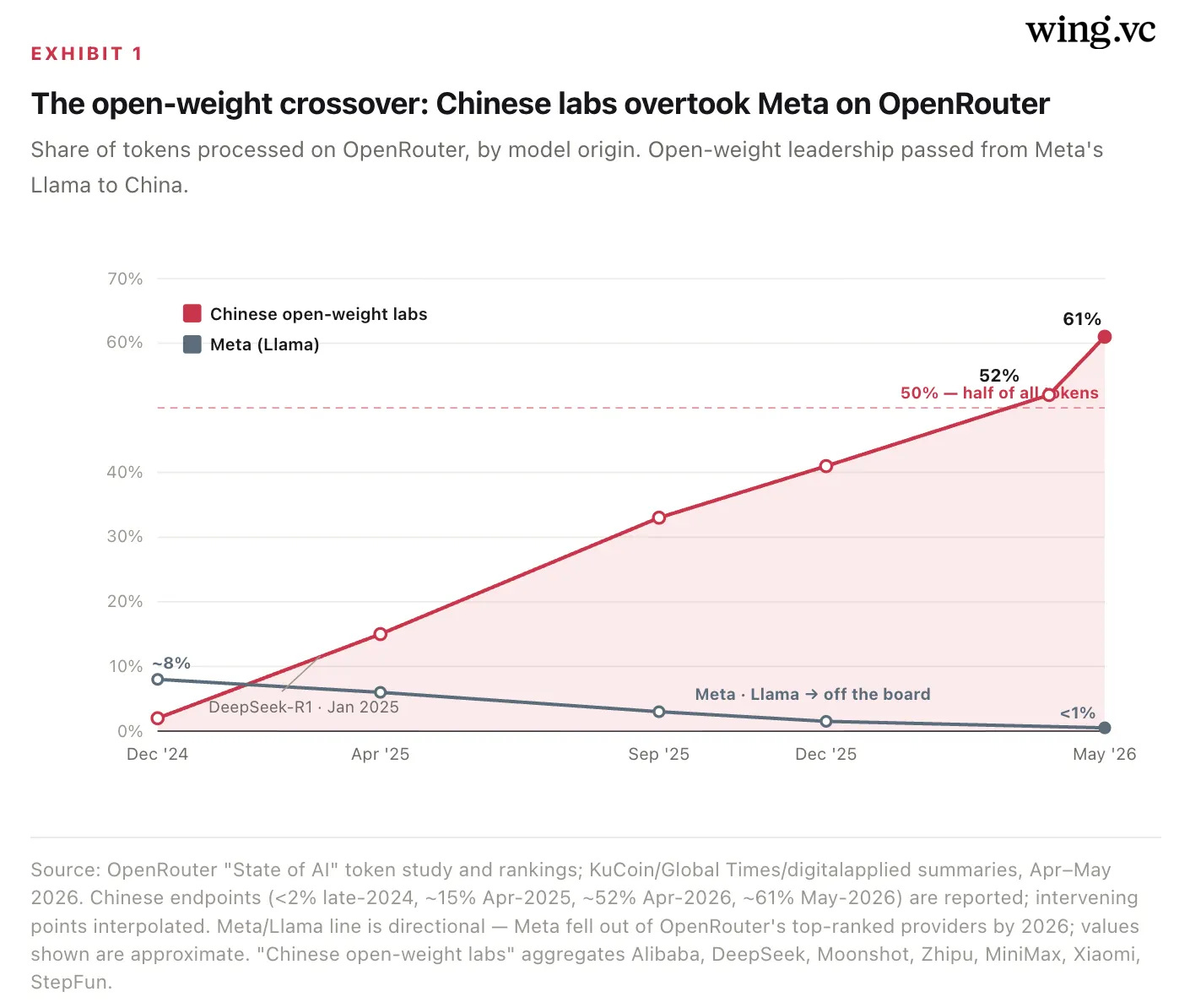
Exhibit 1 from Wing VC’s “China’s Open-Weight Takeover”. The endpoint figures are reported, the points between them interpolated, and the Llama line is directional.
The Times reports that US firms were hardly present. Two blocs bidding gives a buyer leverage, for as long as both are actually bidding, but the terms that decide dependency sit further down the contract than the model. The United States wrote them out in 2024: OMB’s AI acquisition memo required agencies to plan for training their own staff, to keep data and models portable, and to make vendors document their tools, techniques and coding methods well enough that somebody else could take the system over.
Those clauses are the part worth copying, and they are available to any buyer. The coalition the labs asked the G7 to build would govern a market they did not turn up to compete in.
Assorted links
- Merve Hickok reads the White House memo ordering agencies to buy unbiased language models: the compliance evidence is the vendor’s own attestation, and installed contracts are reworked only “to the extent practicable”, so the standard binds your next procurement and not the system you already run.
- Nearly 3,000 signatories, 16 Nobel laureates among them, ask for research into what AI does to the economy and decline to recommend a next step, which is what reaches a finance ministry in place of a number it could plan against.