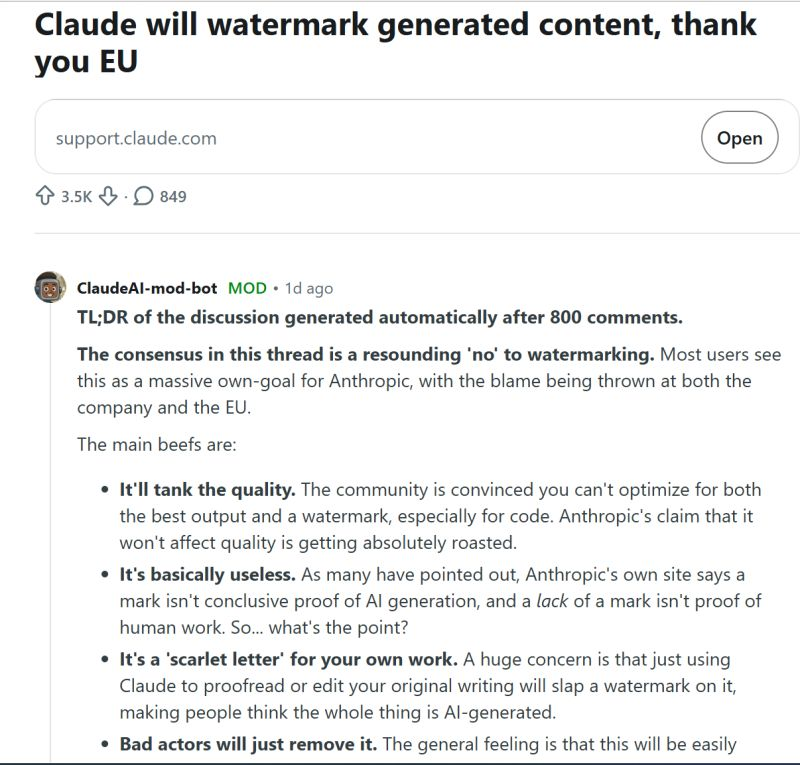
Reddit reaction to Anthropic’s watermarking announcement.
Reddit is angry about Anthropic’s decision to watermark Claude-generated text.
Anthropic says supported Claude models launched in the European Union on or after 2 August 2026 will carry machine-readable marks. The marks apply across Claude, Claude Code, Claude Cowork, the API, and cloud partners where Claude is offered. The European Commission’s Article 50 transparency regime asks providers to make AI-generated content detectable, and Anthropic is implementing that obligation globally.
The narrow technical claim is clear. A detector may show that Claude touched a piece of text. It cannot tell whether Claude supplied the argument, corrected the grammar, translated the sentence, summarised a source, or converted a file. Anthropic’s own limitation note says as much. The mark records processing and stops there.
That distinction matters most for people who already pay a tax on language. For decades, schools, employers, journals, donors and bureaucracies have graded how smoothly an idea arrives and called that the quality of the idea. Birthplace, schooling, class, disability and first language decide how much polish a person must buy before the substance is heard.
AI writing tools can reduce part of that penalty. A Ugandan researcher, a Serbian civil servant, a Brazilian activist or a dyslexic programmer can use a model to make English less expensive while keeping the argument their own. That gain is real.
A watermark risks reattaching stigma to the correction it makes possible. The mark says AI touched this. A hiring committee, journal editor, grant reviewer, procurement officer or teacher may read it as less authentic, less capable, less trustworthy. Pierre Bourdieu spent a career showing how institutions mistake linguistic competence for intelligence and call the result merit. He named the mechanism symbolic violence.
Provenance is still worth having. Deepfakes, mass impersonation, automated political spam and fraud need hard labels, files need provenance, and platforms need abuse signals. But prose behaves differently from an image, and editorial assistance is a long way from impersonation. Text moves through translators, editors, spell checkers, speech-to-text systems, templates and colleagues. Claude is one more machine in that chain.
That leaves a narrower policy question: when should a detector be allowed to stand in for a judgment about authorship? A regulator that wants transparency without reviving the old language hierarchy would treat the mark as one clue in an audit, weighed against the others, and never as evidence about the person who filed the text.